If I started learning trading again, I’d do it this way.
I will be straight forward: trading is a hard skill to master. I’ve made tons of mistake, made things complicated than it should be. But important I’ve been…
Market data in this article is as of 5 October 2021 and is used for illustration only.
I will be straight forward: trading is a hard skill to master. I’ve made tons of mistake, made things complicated than it should be. But important I’ve been learning what works and I’ve been discarding what is irrelevant, at least for me. And if I were given the chance to go back in time and start all over again with the same knowledge that I have in the present moment, I’m sure I would do things differently. Inorder to sow the effect of compounding as a trader, we need time; and so much time is lost as we try to figure out the way to become profitable. I hope this article finds your way and I pray that you take home at least one golden nugget that will save you time in your journey.
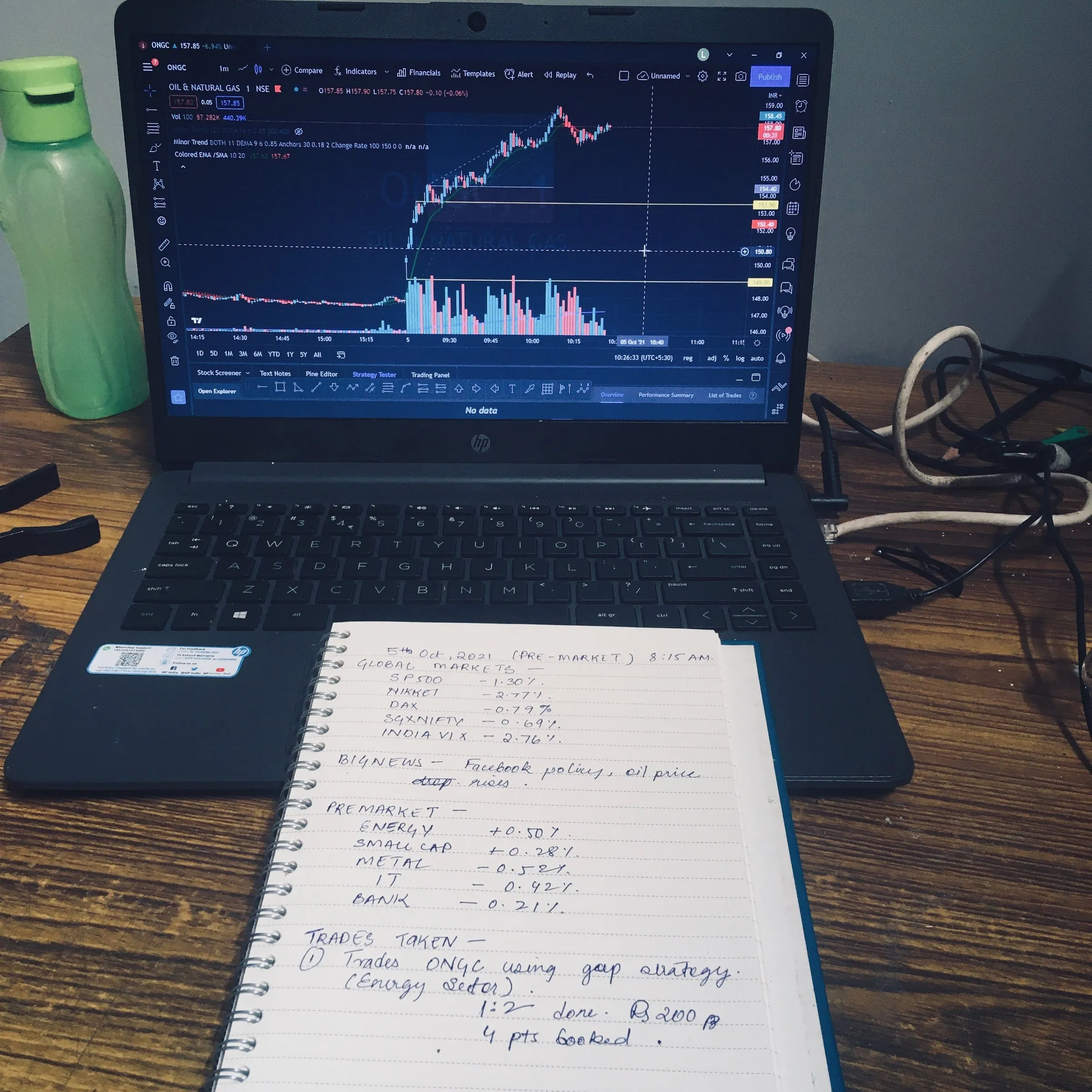
My trading desk back in 2021
There is no shortcut to success, but you can cut short the learning curve.
It’s true that we learn by our own experience, but what’s wiser is: learning from the mistakes of others and trying to avoid those events that has made people fail. That was what I did back when I started: I avoided the pitfalls of unprofitable traders. Though I made mistakes along the way, I did not fell deep into any losing pits. I did fell into traps but it was always shallow enough to crawl my way back to the top again. This was because I was aware of the things that made traders blew their accounts just to say “Trading is a gamble, it doesn’t work”. If I had lost my way and my risk of ruin (chances of blowing capital) is high, I took breaks. I would go back to the basics, relearn everything and try again. So, the first advice I have for anyone reading this is: Learn from your mistakes, but most importantly learn from those who failed and try not to repeat your mistakes and theirs.
Buy and Hold Wins in The Long Run
There is a reason why Warren Buffet is Warren Buffet. He has such strong will, power and the discipline to hold fundamentally strong stocks. If it wasn’t for this trait, we wouldn’t know him as the Oracle of Omaha. As a trader we are bounded by the definition that a trader is someone who buy and sell an asset over a short period of time or in another words, a trader is someone who speculates. But here’s my take: Do not be bounded by definitions. Take a trade and as long as the trend is intact - sit on it. But if it is going south towards your stop loss, yes, cut your losses. I learned this lesson in the late 2022 to late 2024 bull run. I was always selling early because my timeframe to hold a trade was a few weeks and not more than two months. I was lucky to realise it early, if not, I would be missing majority of the bull run. We need to understand that when you exit a trade to find a new trade, you are taking a whole new open risk, as a trader you must try to minimise risk but maximise your reward (Modern Portfolio Theory Concept). In my experience, the best way to achieve this is to hold on to your winners.
Anyone can learn Technical Analysis, but discipline is hard to master.
I used to joke about Technical Analysis, “If I taught my neighbour about Technical Analysis, who is still wet behind the ears, he’ll come out as an average person who knows and understand Technical Analysis in a week”. I am not saying this to put TA as a method that doesn’t work, I use Technical Analysis most of the time, in fact, I use it more than Fundamental Analysis (though it is very important to master both). The thing with Technical Analysis is that, it gives you the idea that you can make it work by throwing indicators over candlestick charts. But the reality is far from the truth. You need to understand that Trading is a game of chances and probabilities, and technical analysis is only a very important tool that reveals how strong your hand is or, in other words, it tells you when and where your chances of winning the trade is highest. You must learn Technical Analysis as a trader. But don’t make it as the number one thing that matters. Instead, build a structured rule-based system around your understanding. This structured rule-based trading is called Systematic Trading. Learn to follow the rules, live by the rules and your mandates. And by doing so, surely you will be casting off all the trading demons like FOMO, Greed, Fear etc.
Don’t Jump into Options Trading too Quickly.
Options (or any derivatives) in the hands of the inexperienced is a weapon of mass destruction for the person. The official report from SEBI stated that 95% of retail traders lost their money trading options. The problem with Options trading is that the entry barrier is too thin. A Out-of-the-Money premium of ₹20 with lot size 75 require only ₹1500 to kick start the gambling trap and who wouldn’t like their ₹1500 blow up to ₹4500, a return of 300% within a short period of time? The sad reality is that options buying by default has a chance of 33% to expire with an intrinsic value. Let me put it this way:
-
A newbie retail trader with little to zero knowledge of options came to know about how his friend luckily tripled his capital in less than 10 minutes. So he wanted to do the same instead of traditional boring buy and hold of stocks.
-
He tried, got lucky, tripled ₹2000 to ₹6000 in one day.
-
He wanted to do it again the next day. So he did, but this time he lost ₹2000 buying a worthless option contract.
-
He said to himself that losses are supposed to happen, so he tried again and lost ₹2000 again. He had ₹2000 still remaining so he said to himself “Why not?” only to lose every including his capital to the bigger sharks.
-
He got emotional the next day, so he topped-up ₹2000 again only to fail and lose everything again.
-
He did this multiple times, winning in some cases but since the odds are off the shore for him, he loses more than he ever thought he would.
If you read carefully about his behaviour, you will notice a trait similar to something you’ve heard before, a vice that our parents told us to stay away from. Yes, you’re right it’s Gambling. The illusion of making quick profits made Lakhs of retailers lose money gambling options. The numbers got so big that the regulator SEBI had to change lot size and remove weekly expiries. So if you are still with me reading this: Don’t rush into trading options. It is indeed a great and wonderful tool if you know how to use it the right way, learn everything about it first, don’t leave any stone unturned. Master how it works it first and trade it last.
There are many other important learnings that I want to share. But it will be too lengthy for a single post, so I will end it here for now. My conclusion is this:
Trading is a tough job to take up. The market will make you bend, try to learn from your mistakes and other’s. Buy and Hold wins in the long run, learn to trade systematically to trade with discipline and master how options work first before jumping right in.
Until then, take care. Happy Trading!
[I hate AI generated blogs lol, clearly this one isn’t]